Why Water is Free in Korean Restaurants: Self-Service & Water Purifier Rules
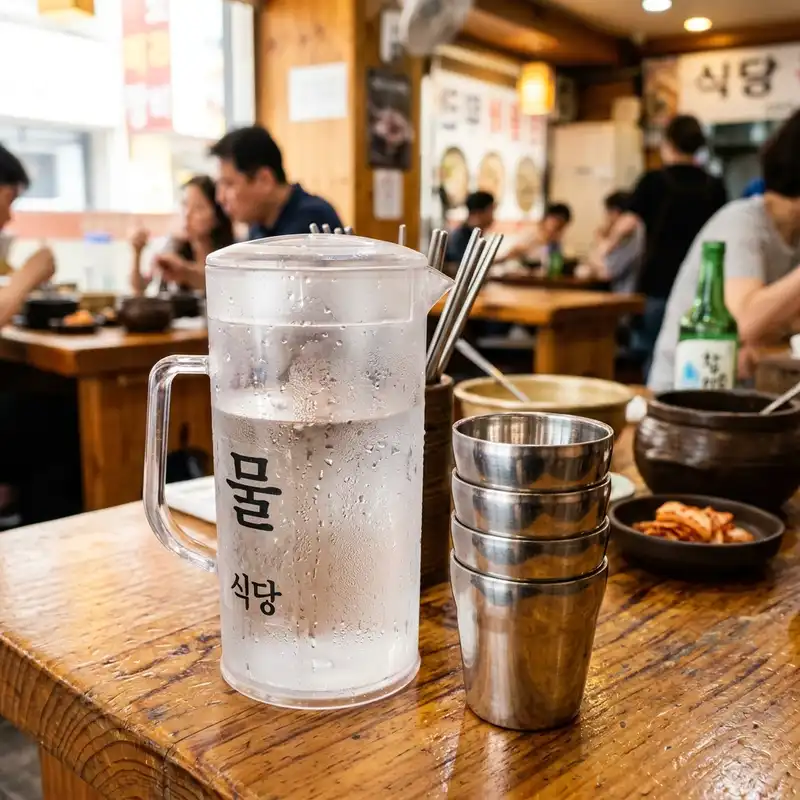
Practical Guide to Korean Restaurant Water Culture for Tourists
In most Korean restaurants, there is no need to hesitate or open your wallet to drink a glass of water. Just keep these tips in mind to adapt more easily!
- Usually Free (Usually Free): Water in Korean restaurants is generally free and is rarely added to your bill. At many places, the staff will bring you a pitcher of water when you sit down. Some restaurants, however, sell bottled water or drinks separately, so if no water arrives, it is fine to ask the staff. The water served is usually filtered and purified, so you can drink it with peace of mind.
- The Meaning of Water is self: If you see a sign on the restaurant wall saying Water is self, it means the staff will not bring water to you. Don't panic! Just take a cup out of the ultraviolet sterilizer (Stainless sterilizer) on one side of the restaurant and use the water purifier, or grab a cup and pitcher from the water dispenser (Water dispenser) or refrigerator and drink as much as you want.
- Caution When Using Hot Water from the Purifier: Water purifiers have both hot and cold water. To get hot water, there is an extra button on the upper part where the water comes out. Press that button first, then press the tap below once more, and hot water will come out. Be especially careful when dispensing hot water, as you could burn yourself if it accidentally touches your hand.
- What is the Brown Water?: Sometimes, instead of clear water, you might be served cold, brown water. This is not dirty water, but rather roasted barley tea (Bori-cha) or corn silk tea, which Koreans love. It's caffeine-free and has an excellent nutty flavor, so you can drink it with peace of mind.
Recently on the news, I heard that in Europe and many other countries, you have to pay a fairly expensive price just to drink a glass of water at a restaurant. Hearing this, a common scene in Korean restaurants—something I experience every day and take entirely for granted—flashed through my mind. In Korea, no matter which restaurant you go to, the very first thing that arrives at your table the moment you sit down is 'cold water' in the summer, and 'warm water' in the winter.
A Pitcher Set Down Before You Even Order
On a hot summer day, when my family and I walk into a neighborhood Korean BBQ place or soup restaurant sweating profusely, even before our bodies fully settle into the chairs, the restaurant "Auntie" (server) swiftly places a plastic water pitcher covered in cold condensation and shiny stainless steel cups quietly on our table.
Looking at the menu or ordering food is always the second step. First, you pour that ice-cold water up to the brim of your cup, gulp it down, and only after letting out a deep sigh of relief do you finally have the luxury to look around. Quenching your thirst with cold water before a meal like this is a service as natural as breathing in Korean restaurants, and anyone can enjoy it without paying a single dime.
Korean restaurants serve cold water by default. If you would prefer warm water, simply ask the staff, "Warm water, please," or use the hot water button on the water purifier.
The Nostalgia of Ice-Cold Roasted Barley Tea
When you visit very old and traditional Korean restaurants, you will sometimes find that instead of plain water, they serve roasted corn tea, Solomon's seal tea (Donggullae-cha), or a deep brown, nutty roasted barley tea (Bori-cha). Every morning, boiling water in a massive pot, steeping tea bags or roasted grains, and then cooling it down in the refrigerator is no small hassle for a restaurant owner. Nevertheless, when I think of the owners who willingly take on this trouble simply because "tea tastes more savory and better than plain water," I can feel their deep affection (Jeong) and care for their guests infused in a single glass of water.
In fact, the act of serving water first to a guest in Korea stems from a very old, traditional culture of hospitality. In the old days, our ancestors would draw cold well water and offer a bowl to an exhausted, sweat-drenched traveler who came a long way, allowing them to catch their breath. The old folklore of floating a willow leaf on the water so the traveler wouldn't drink too fast and choke is a small example of that habit. This culture of treating guests first has carried over into the 'water service' of modern restaurants.
The No-Judgment Infinite Refill Purifier
Finishing one pitcher of water doesn't mean it's over. Tucked in the corner of almost every restaurant is a water purifier. If you need more water during your meal, you can just walk over and refill your pitcher to the top, and absolutely no one will bat an eye. In fact, if you stand up with an empty cup while eating, you'll often see the busy owner rushing by and saying warmly, "Out of water? Sit down, I'll bring it to you~"
Not only side dishes but even water can be refilled as much as you want. Even if you visit a small cafe or a local snack shop (Bunsik-jeom), there is usually a clean water purifier and cups available, with a small sign that says 'Water is Self-Service.' Clean water is kept within easy reach for anyone who is thirsty.
Cultural Guide: Why is Water Free in Korean Restaurants?
In Korea, offering drinking water has traditionally been considered the most basic courtesy toward a guest. Historically, households would brew roasted barley or corn tea to offer visitors. Today, this tradition is supported by Korea's highly advanced water purification infrastructure. Almost every commercial establishment is equipped with powerful water purifiers (정수기, Jeong-su-gi), making clean, chilled, and filtered water abundant and virtually cost-free to serve.
A Deep Sense of Gratitude
When I listen to friends who have traveled abroad or foreigners visiting Korea, I often hear that not only do they have to buy water, but even the complimentary tap water served in overseas restaurants is sometimes hard to drink due to the high limestone content.
Hearing these stories, there are times when I find the strictly capitalistic restaurant culture of overseas countries genuinely unfamiliar and surprising. It's quite different from the sentiment of Korean people, who consider a restaurant to be more than just a commercial space to pay for and consume calories, but a place to receive comfort while eating a warm meal carefully prepared by someone. Simultaneously, I feel a renewed sense of awe at the generosity of my own country, where thoroughly purified, crystal-clear water is given out without a second thought the moment you walk in to eat.
Especially when I take my elderly parents, who live in the countryside, out for a meal, I realize how comforting and fortunate this Korean culture is. Even my parents, who are clumsy with digital devices or complex ordering systems, are quickly put at ease by the kindness of the staff who approach them the moment they sit down, offering a cool cup of water and saying, "Please have some water first." Thanks to that single glass of water, our family dining experience begins on a much more cheerful and harmonious note.
We live in an era where people constantly complain about the harsh world and terrifyingly rising food prices. Yet, at least when I see the generous affection of restaurant owners who never act stingy over a glass of water for a thirsty person, a corner of my heart warms up. Living in a country that first welcomes guests walking through the restaurant door with cold water—sharing my daily life here in South Korea with my family—is a fact that feels truly reassuring and something I am deeply thankful for.
📌 Recommended Posts
이 리뷰를 한국어로 읽고 싶으신가요?
🇰🇷 한국어 리뷰 읽기